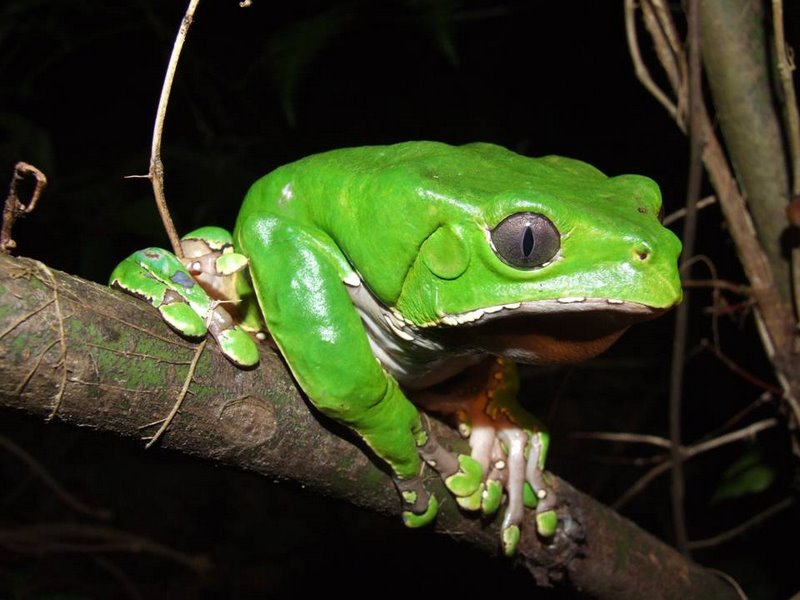
Kambô, also known as the “frog vaccine”, is the cutaneous secretion of the frog Phyllomedusa bicolor, native to the Amazon rainforest. Traditionally it is associated with “taking out panema”.
Panema can be translated as “bad luck”, especially in hunting, but also in love. This article describes the traditional context, what is reported about the process and why caution is necessary.
Kambô is the secretion of the Phyllomedusa bicolor frog, used originally in connection with the native concept of removing panema – bad luck in hunting and in love.
Source
Phyllomedusa bicolor
A frog native to the Amazon rainforest, whose skin secretion is used in the tradition.
Concept
Panema
Translated as “bad luck”, especially in hunting, but also in love. Kambô is associated with taking it out.
Nickname
Frog vaccine
Kambô is also known as the “frog vaccine”.
The Noke Koi (Katukina) are among its frequent users. Read more in our articles on the Katukina (Noke Koi) and the Shawãdawa, who also practice a kambô ritual for the hunter.
Process
How the secretion is traditionally applied
The following is a description of the traditional process as reported, for information only.
1
Early morning
Early in the morning, ideally before sunrise, the recipient is fasting and drinks only water or caiçuma, a fermented cassava drink that facilitates vomiting.
2
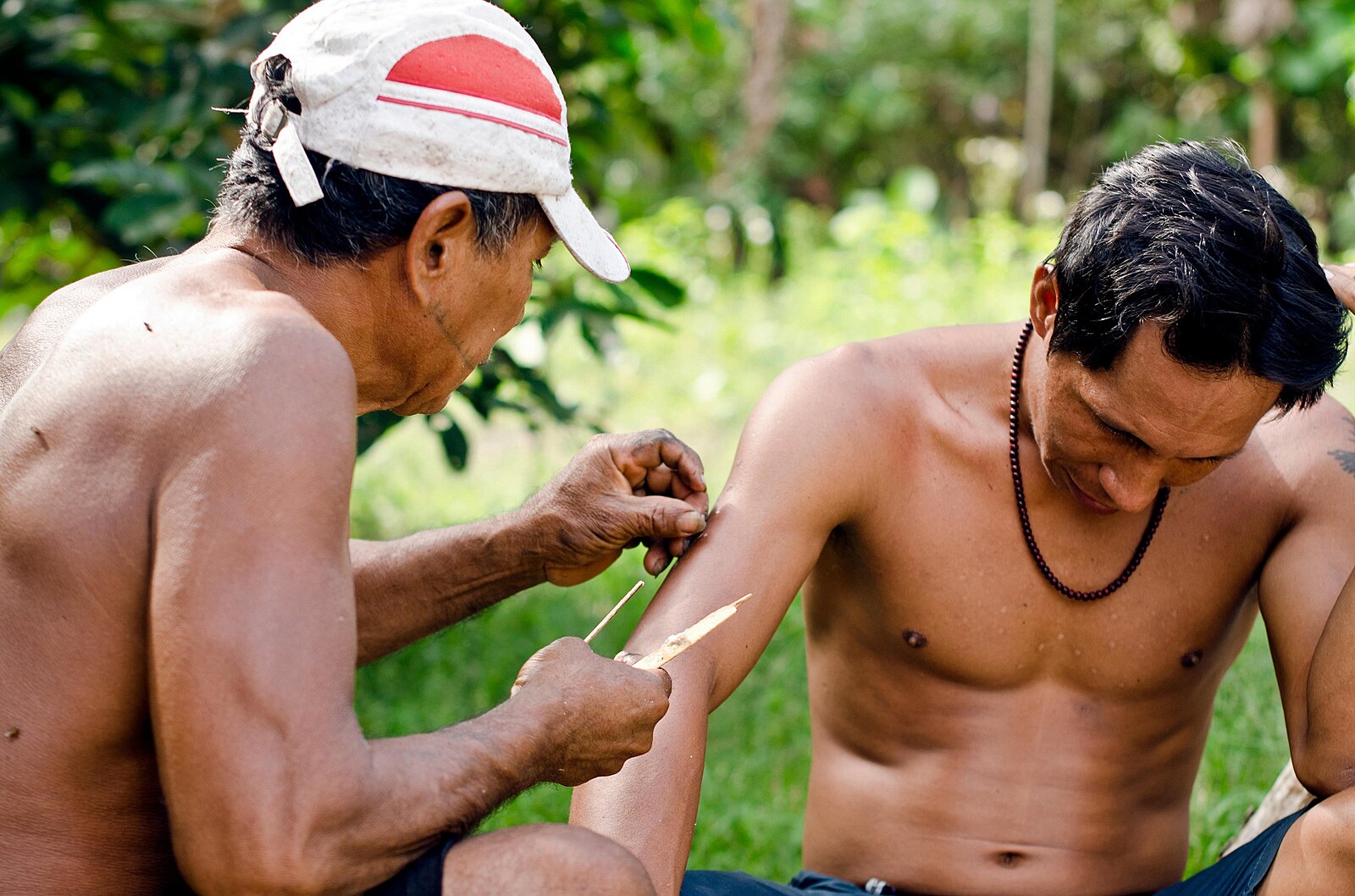
Small burns
The applicator sets a vine (known as cipó titica) on fire so that it is red-hot and uses the embers at its tip to make small burns in the form of “points” on the skin.
3
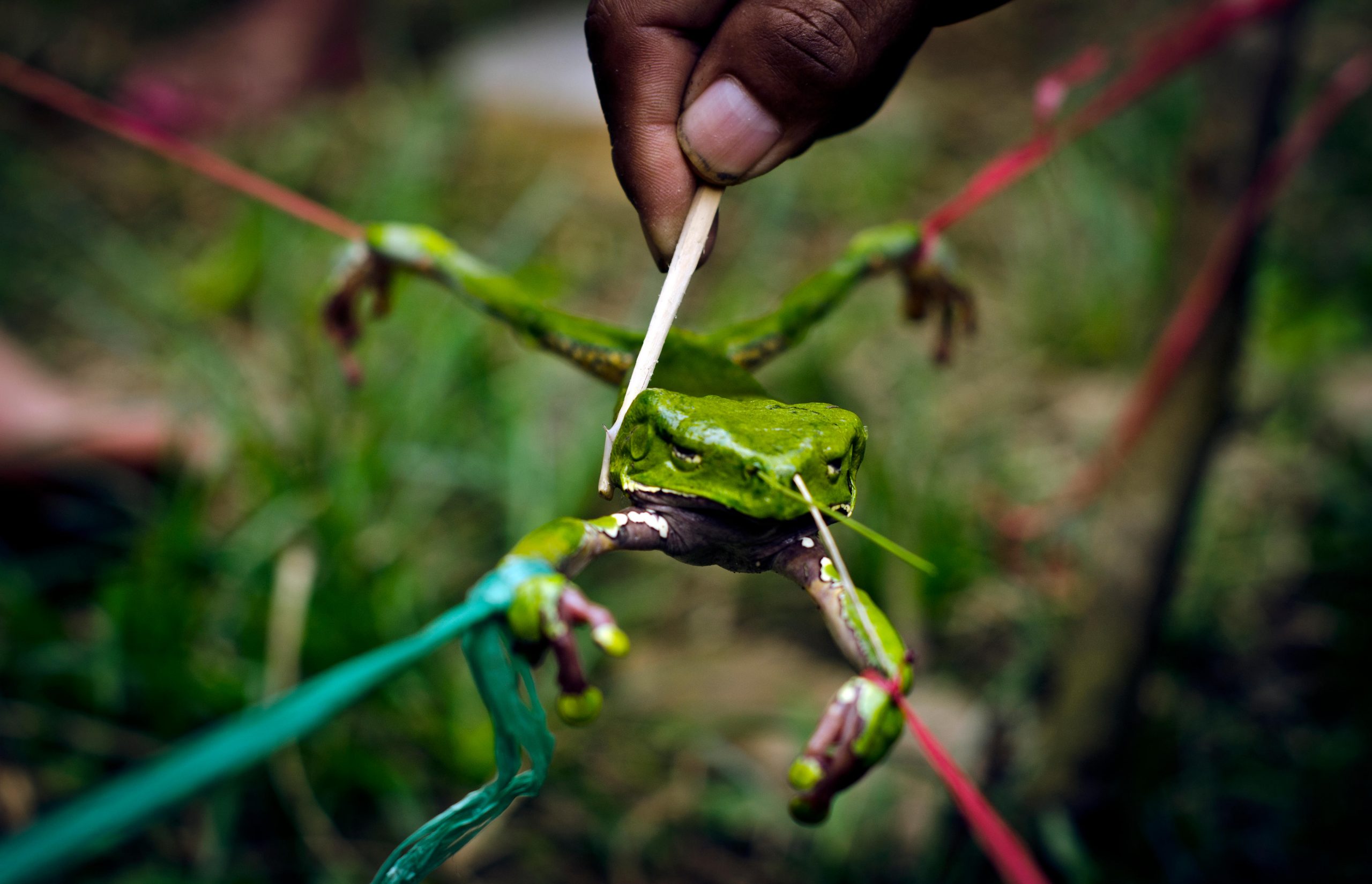
Secretion
The burned skin is removed and the secretion, previously hydrated with water, is superficially inserted at these points.
Number of points
From 1 to 300+
From just one or two to over three hundred, as reported by the Noke Koi. Most commonly, among non-indigenous people, three to at most twenty.
Reactions
Reported reactions
The first reaction is an increase in blood pressure and heartbeat.
The face is usually swollen, especially the lips, which gives a very unusual appearance. Next, the blood pressure seems to fall sharply, and some people even faint. The expected effect is that the person vomits bile, yellowish or greenish, but not all vomit. A rest period of a few hours to a few days follows, and the usual effect is then described as a feeling of great physical well-being.
Experience
How the author met Kambô
“I met kambô in the late 1990s; not through an indigenous person, but through former rubber tapper Francisco Gomes Muniz, an Amazonian mestizo with extensive forest experience.” Through a set of happy coincidences, Francisco discovered an intriguing parallel between the native concept of misfortune in love (panema) as a consequence of “clogging the heart” and the contemporary medical concept of clogged arteries that can be treated by a doctor with catheterization.
Following this concept, Francisco started applying kambô to people with various health complaints and, in most cases, improvement or total cure was reported. Since then, patients themselves have cited kambô as a direct cause of cure or amelioration of a growing body of diseases, but without its effectiveness having been proven in terms of modern medical science. It is important to note that caution is necessary in evaluating these claims.
Safety
Reports of deaths and why caution matters
Kambô can be dangerous for people with a history of heart problems.
If on the one hand kambô can reportedly heal assorted diseases, there is also an increase in reports of deaths associated directly or indirectly with its use. The Noke Koi say that, historically, kambô has never caused a death, but with its use expanding each year beyond the geographical boundaries where it was confined for centuries or millennia, news of related deaths is increasing. There is not enough research to say why; perhaps it is only due to the increased sample size and exposure to people with unknown health histories.
Another point is that dosage does not follow very objective criteria. The applicator uses intuition to determine the dose for each person, and an experienced applicator can moderate the effect by using water at the application site. People who offer this medicine in large centers are often not sufficiently trained in these subtleties.
This text is for information and education only and is not a recommendation to use. Consult a doctor with any health question.
Tradition
The role of the applicator
For the natives who use kambô traditionally, the person who applies it matters a great deal.
In the native concept, the substance is only part of what is applied. The other part refers to the qualities of the applicator – a good hunter, a good worker or, eventually, a good healer – who wants to pass these qualities on to the recipient. The substance is a vehicle for such qualities to be transmitted and imprinted on the recipient’s body.
You can find scientific works on kambô online, for example here and here.
FAQ
Frequently asked questions
What is Kambô?
The cutaneous secretion of the frog Phyllomedusa bicolor, traditionally associated with taking out panema – bad luck in hunting and in love.
What is panema?
A native concept translated as “bad luck”, especially in hunting, but also in love.
Is the effectiveness of Kambô proven?
No. Patients report improvements, but its effectiveness has not been proven in terms of modern medical science, and caution is necessary in evaluating such claims.
Is Kambô safe?
There are increasing reports of deaths associated with its use. It can be dangerous for people with a history of heart problems, and dosage is determined by intuition rather than objective criteria.
Who uses Kambô traditionally?
Among others the Noke Koi (Katukina), who consider themselves the first nation to receive it directly from the frog, and the Shawãdawa.
V peruánském Iquitos, Pucallpě či Tarapotu se na trzích a v malých bodegách s plechovými střechami prodávají lahve s tmavě červenou tekutinou. Uvnitř plavou kousky kůry zalité aguardient...
Každé Rapé nese vlastního ducha, záměr či energetický podpis podle druhů popela a rostlin v něm použitých. Některé směsi mohou hluboce uzemnit, jiné otevřít srdce, zaostřit vnitřní v...