

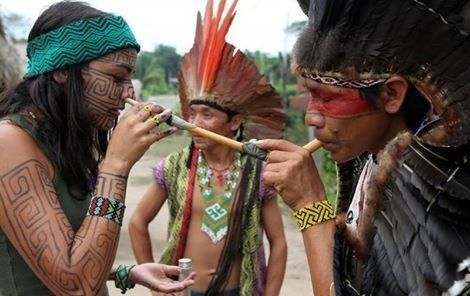
What Is Rapé (Hapé)? Sacred Amazonian Shamanic Snuff Guide
If you’ve found your way here, you’ve probably already seen Rapé spelled five different ways and wondered which one is “right.” Rapé, Hapé, Hapeh, Rapeh, even Ruma — they all point to the same thing, and the spelling depends mostly on which tribe, language, or trader you’re hearing it from. In English it’s pronounced “ha-peh,” with a soft stress on the second syllable. Not “rape,” which trips up almost everyone the first time they read it.
Rapé is a fine, dry snuff made in the Amazon basin, traditionally blown into the nostrils through a small pipe. That’s the short version. The longer version — where it comes from, what it is made of, how the tribes prepare it, and what it means within their traditions — is what this guide is for.
Most of what circulates online about Rapé is either recycled from the same handful of blog posts or quietly invents things to sound mystical. This is the version we’d give a friend who asked us, “Okay, but what is this stuff, really?”
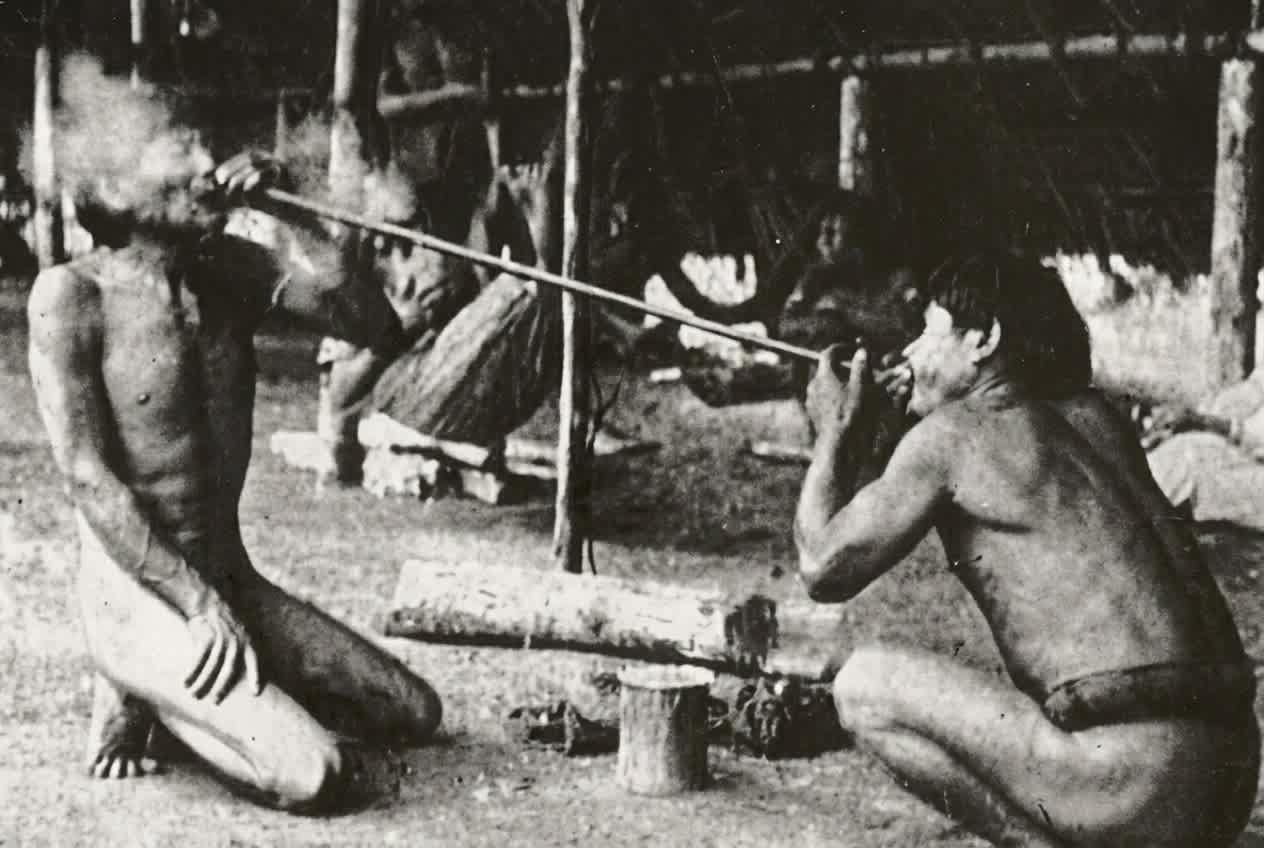
What Rapé actually is
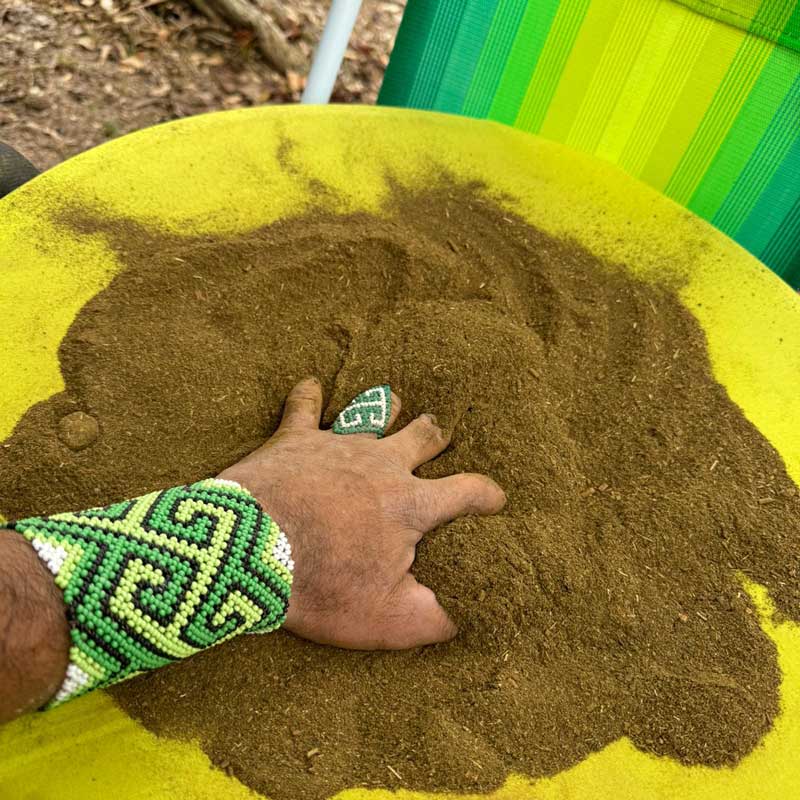
At its simplest, Rapé is a powder. A very fine one — when it’s made well, it has the texture of talcum and almost no grit between your fingers.
The base of most traditional blends is Mapacho, a strong Amazonian tobacco. This is where a lot of confusion starts, so it’s worth being precise: the tobacco in traditional Rapé is usually Nicotiana rustica, not the Nicotiana tabacum in cigarettes. They’re different plants. N. rustica is far more potent, grows shorter and hardier, and has been cultivated ceremonially across South America for a very long time — long before anyone rolled tobacco into a cigarette for pleasure.
Please note: tobacco contains nicotine. Rapé made with Mapacho is therefore a nicotine-containing preparation, not a harmless herbal powder. Nicotine can lead to dependence, and such blends are not suitable for minors, pregnant or breastfeeding women, or people with health conditions.
Mixed into the tobacco base is ash. Not just any ash — it’s made by burning the bark or branches of specific trees, each chosen by tradition for the qualities it’s said to carry. Tsunu, Murici, Cumaru, Caneleiro: different woods, different character, and the choice of ash is a big part of what separates one blend from another. Some recipes add ground herbs, seeds, or leaves on top.
So when someone asks “what’s in Rapé,” the honest answer is: it depends entirely on who made it and which tradition they’re working from. There is no single recipe. That variety is the whole point, and it’s why two blends both labelled “Rapé” can differ completely in character.
The fineness matters more than people expect. Traditional Rapé is sifted repeatedly until it reaches something close to 125 microns — fine enough to feel weightless, like talc.
Not every Rapé even contains tobacco, by the way. The most famous exception is Apurinã Awiry, a vibrant green snuff the Apurinã make from a single wild jungle plant — no tobacco, no ash at all. Strictly speaking it’s its own lineage rather than Rapé in the classic sense, but it tends to get grouped in.
A quick word on the name
You’ll see Rapé, Hapé, Hapeh, Rapeh, and others. Here’s the practical breakdown.
We use Rapé and Hapé interchangeably, leaning on Hapé when we want to honour the indigenous pronunciation.
Where Rapé comes from
Rapé is woven into the ceremonial life of many peoples across the western Amazon — particularly in what is now Brazil, Peru, and Colombia. Tribes such as the Huni Kuin (Kaxinawá), Yawanawá, Nukini, Kuntanawa, Katukina, and Shipibo each have their own relationships with it, their own recipes, and their own protocols around who may prepare and share it.
Snuff-taking in the Americas is genuinely ancient — used in the jungle for thousands of years before any European saw it. One of the earliest written traces comes from Columbus’s second voyage, when the friar Ramón Pané recorded indigenous people using a powdered snuff in ritual around 1493.
By the 20th century, cigarettes had largely displaced snuff in Europe and the fashion faded. But in the Amazon, the tribes never stopped — their tradition ran on unbroken the entire time. Today there is a global renaissance of interest in Rapé, with Brazil as the main producer and tribes like the Huni Kuin, Yawanawá, and Nukini still crafting it by ancestral methods.
We dig into this history more fully in our History of Rapé article if you want the whole arc.
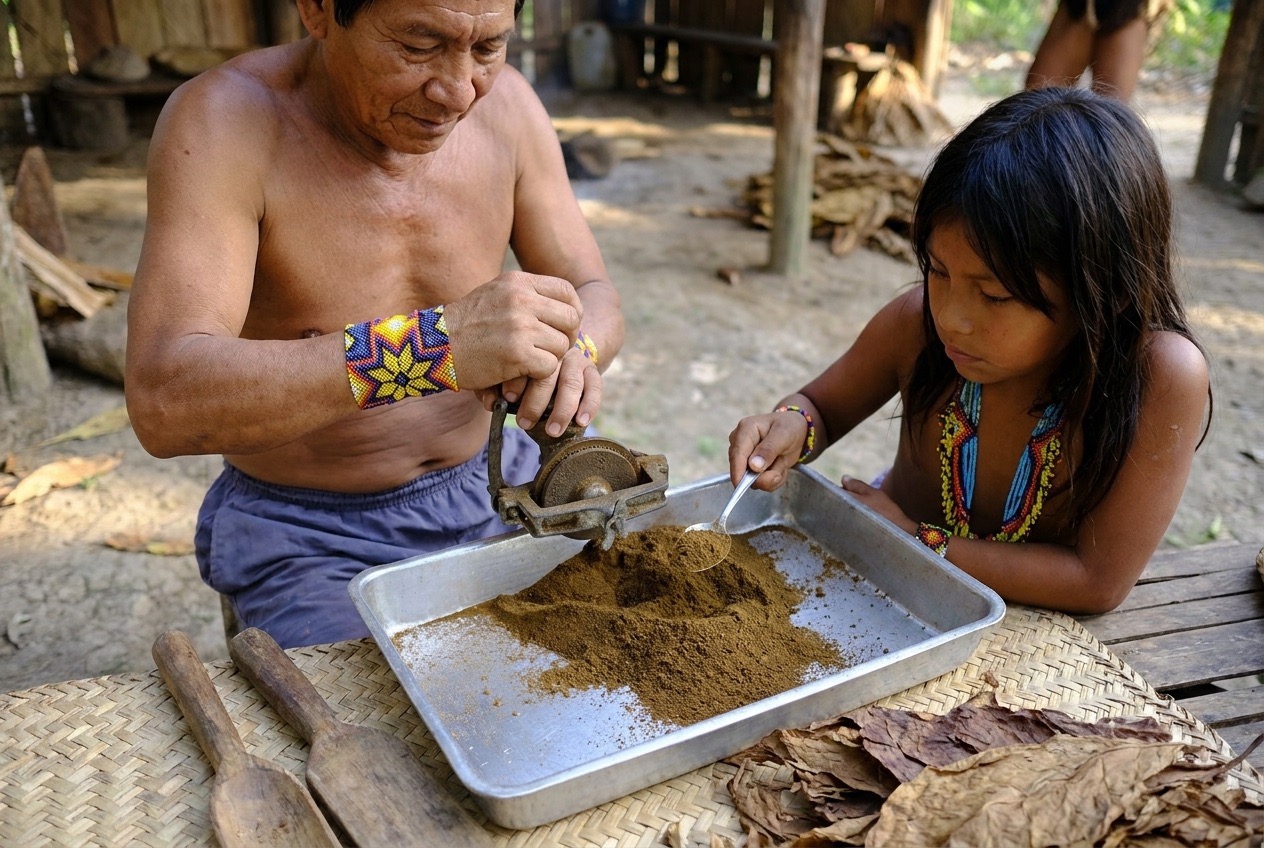
How Rapé is made
This is the part most articles skip, and it says a lot about the culture behind the powder.
Making Rapé is slow, physical work. In the traditional setting, the right to prepare it isn’t open to everyone — it generally belongs to a Pajé (the Tupi word for a shaman or medicine-keeper), an apprentice, or a trusted elder of the community. The recipe and the technique are passed down, not improvised. Historically it’s often the men or the Pajés who make it, though there are beautiful exceptions: the Força Feminina blends are crafted exclusively by the women of the Yawanawá.
The broad process looks something like this:
Step 1
Base plant
The base plant is cultivated, harvested, dried, and toasted.Step 2
Ash
The chosen tree bark or wood is burned down to a clean, pale ash.Step 3
Grinding
Both are ground — historically by hand, with a mortar and pestle, which is genuinely demanding when you’re chasing that talc-fine texture.Step 4
Mixing
The ingredients are combined in proportions the maker knows by feel and tradition.Step 5
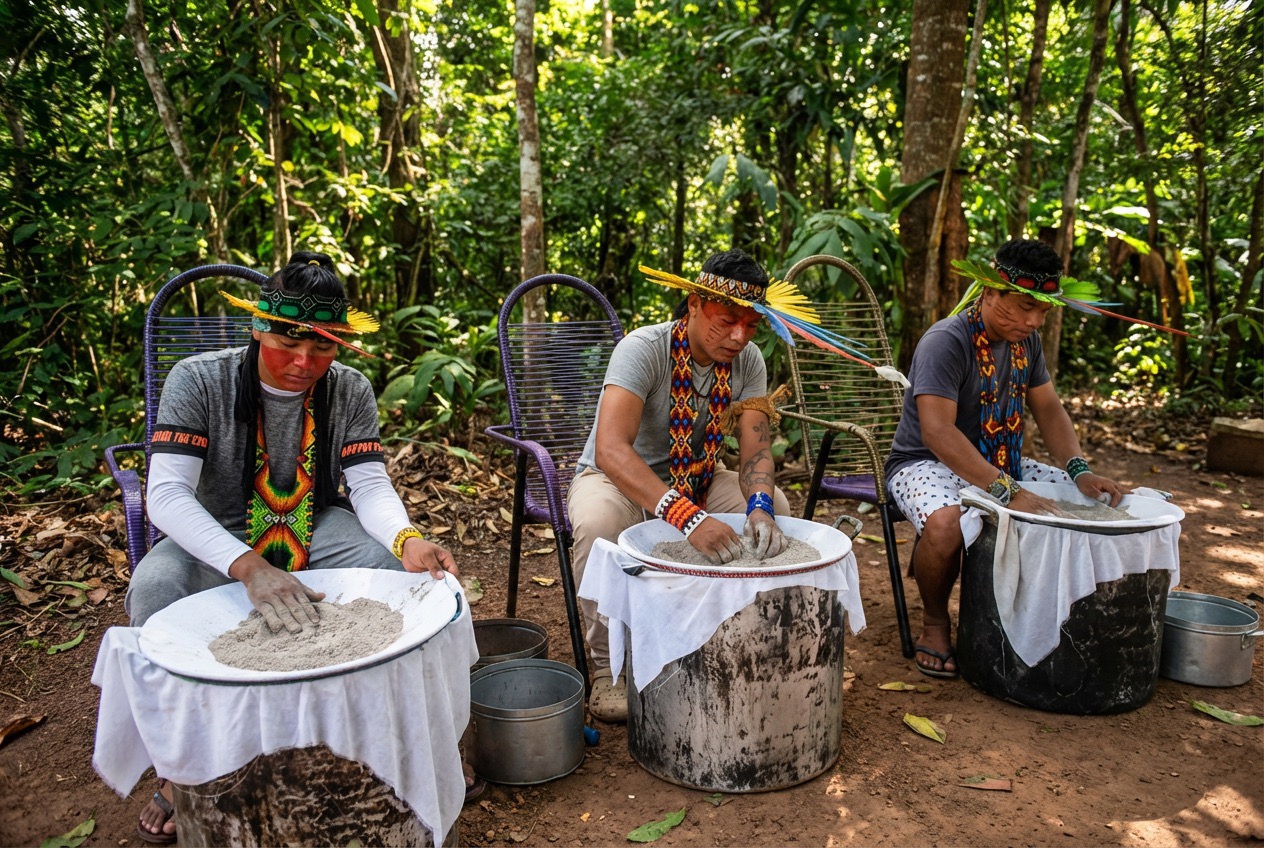
Sifting
The whole mixture is sifted. And sifted again. And again. Each pass through finer mesh pulls out grit and produces a lighter, more even powder.A single batch can take days. This multi-day, small-batch craft is one of the reasons the tradition treats the making as seriously as the sharing.
In the traditions, the preparation isn’t only mechanical. Makers describe holding intention and prayer throughout — the preparation is understood to carry the state of mind it was made in.
The families of Rapé: how the tradition groups them
Most Rapé falls loosely into families, and they map onto how the tradition itself talks about it. The lines aren’t rigid — blend, setting, and intention shape everything. Read what follows as how practitioners describe each family, not as a promise of any result. We cover this in more depth in our guide to Rapé intentions and types.
If you only remember one thing here: the name “Rapé” on a label tells you almost nothing. The family, the base plant, and the ash tell you everything.
Frequently Asked Questions
How do you pronounce Rapé? +
What is Rapé made of? +
Does Rapé contain nicotine? +
Does all Rapé contain tobacco? +
What’s the difference between a Tepi and a Kuripe? +
What does “Haux Haux” mean? +
What is Panema? +
More Q&A you can find in our blog article here.
Tepi and Kuripe: the two traditional blowpipes
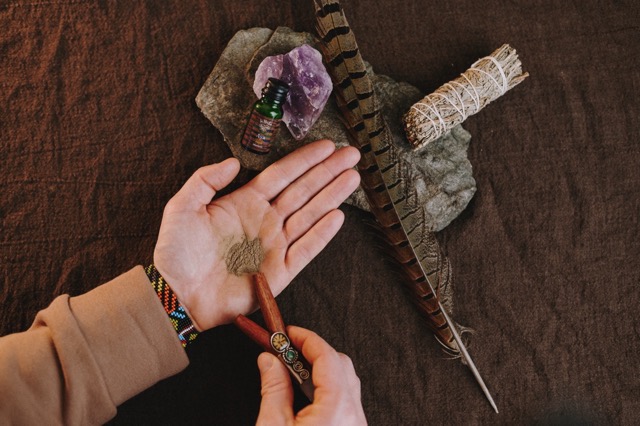
You can’t really talk about Rapé without the tools, because in the tradition it is blown through a pipe rather than casually sniffed. Two instruments are known, and the difference between them is one of the most common questions we get.
Traditional names and symbolism
The tradition also has its own vocabulary. Two blowing styles carry the names of animals: Beija Flor (“Hummingbird”) for a short, sharp blow, and Jiboiá (“Boa Constrictor”) for a long, slow one. The boa is an animal the tribes deeply revere.
Another detail that surprises newcomers: in several traditions, the two nostrils aren’t interchangeable.
Moving from one side to the other is, symbolically, a passage from one state to the next. It is part of the traditional framework, and it explains why practitioners are deliberate about the order.
Rapé in the tradition: what practitioners describe
Here’s where we need to be careful and honest, because this is exactly where most Rapé content slides into claims it shouldn’t make. We’re not going to tell you Rapé does anything to your body. What we can do is describe how the traditions understand it, and what contemporary ceremonial communities report — clearly framed as their perspective, not as fact.
Within the traditions, Rapé is regarded as a sacred medicine. Practitioners most often describe a sense of grounding and presence — being pulled out of mental chatter and back into the body and the breath — and many speak of focus and a clearing of mental fog. These are personal and cultural descriptions, not evidence of any effect, and Rapé is not a medicine in the legal sense.
A note on chakras and the “third eye”
You’ll see a lot of Rapé marketed with talk of opening chakras, activating the third eye, or “decalcifying” parts of the body. Two honest things.
We flag all this not to be killjoys, but because you deserve to know which parts of the online “Rapé lore” are traditional and which are modern Western additions.
Important information
Bringing it together
Strip away the marketing and Rapé is a remarkably specific, hand-crafted thing within Amazonian culture: a talc-fine snuff prepared slowly by people who treat the making as seriously as the sharing, in a moment of intention. Everything that makes it worth learning about — the range of blends, the depth of tradition, the care of real makers — is also what makes it impossible to reduce to a single line.
Haux e muita alegria <3
Disclaimer – ethnobotanical sample
This natural product is offered exclusively as an ethnobotanical sample for ethnographic, historical, cultural, educational, and research purposes. It is not intended for ingestion, inhalation, smoking, or any form of internal or medicinal use. Handling and use are entirely the responsibility of the purchaser. Further details can be found in our Disclaimer.
Sananga FAQ - Často kladené otázky o Sananze
Často kladené otázky o Sananze
Základy
Co je Sananga
Co je Sananga? +
Sananga je tradiční amazonská substance připravovaná macerací kořenů rostlin z čeledi Apocynaceae. Pochází z ...
Pixuri (Licaria puchury) strom
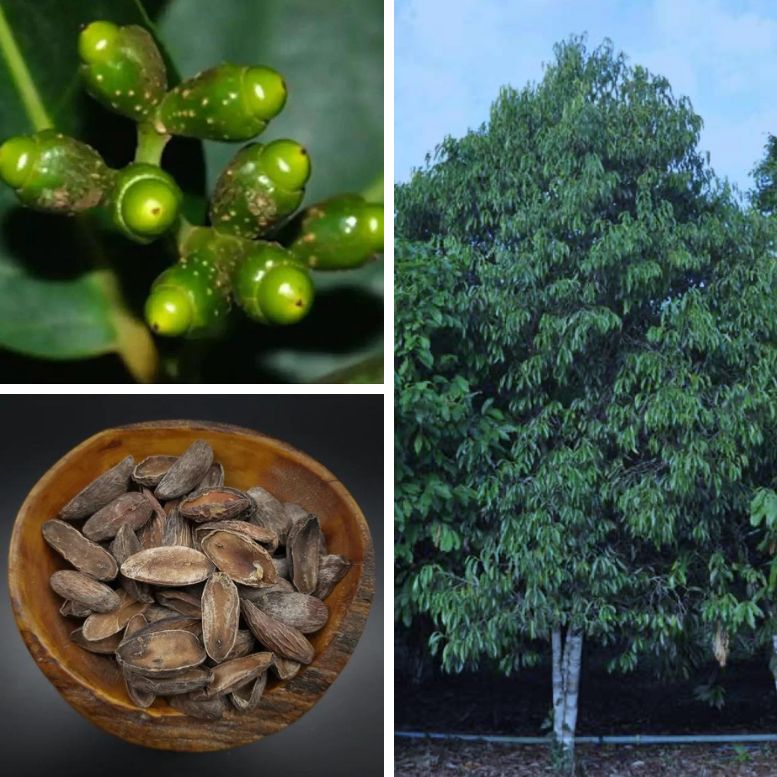
Licaria puchury – major z rodiny Lauraceae. Z tohoto stromu se využívají zejména jeho velká tmavá semena a listy. Semena...
Sakrální čakra a Rapé: cesta k emocím, radosti a tělu
Rapé (hapé) je posvátná amazonská medicína, se kterou pracují domorodé kmeny už stovky let. Na Západě ji vnímáme čím dál více i jako nástroj spojovaný s energetickou prací – symbolickou oči...
Katukina (Noke Koi) kmen
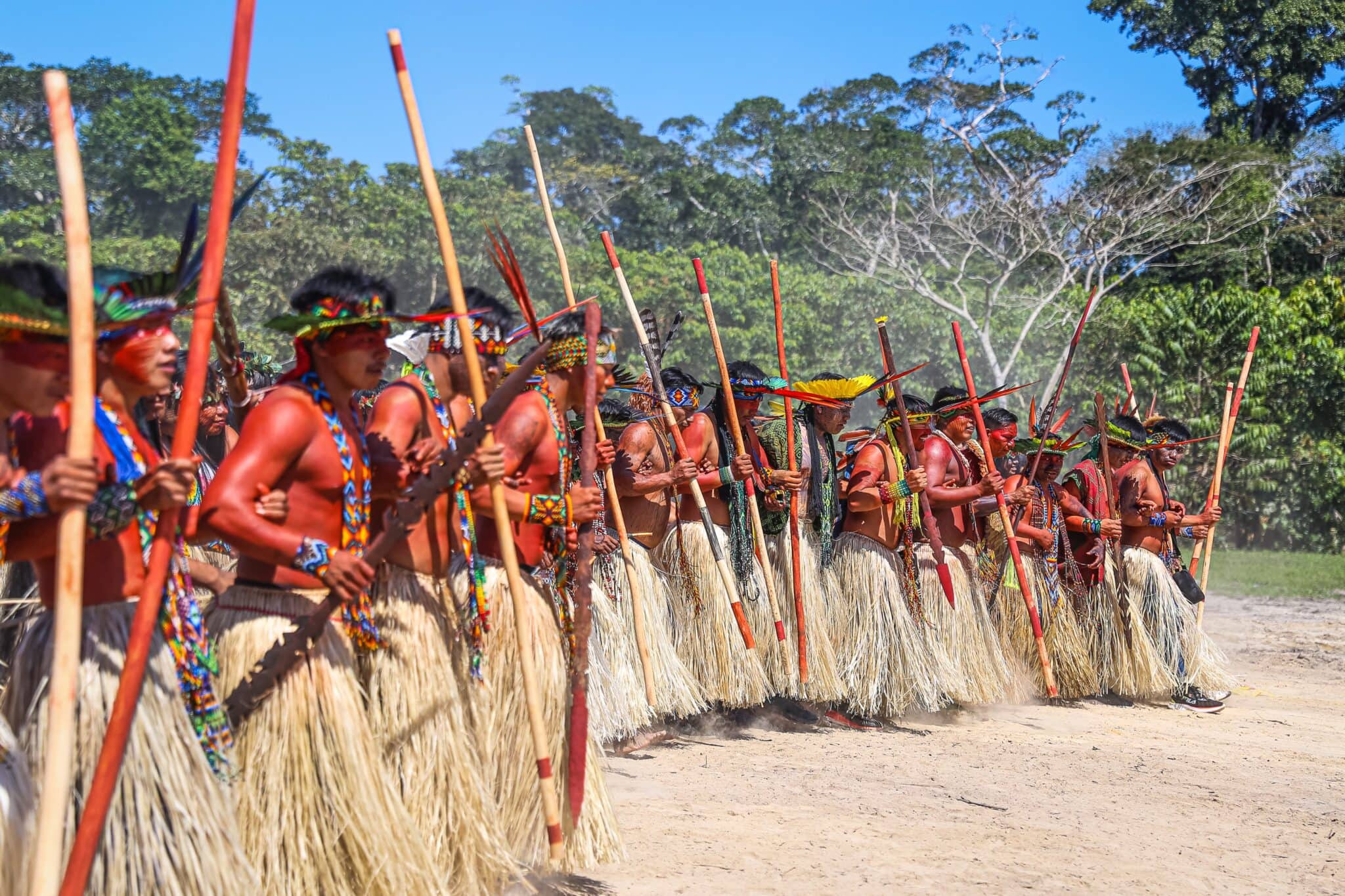
Vnější svět je zná jako Katukina. Oni sami se nazývají Noke Koi – „praví lidé“. Národ, který si navzdory více než stoletému tlaku zvenčí uchoval jazyk, klany i tradiční medicíny.
Na pomez...

